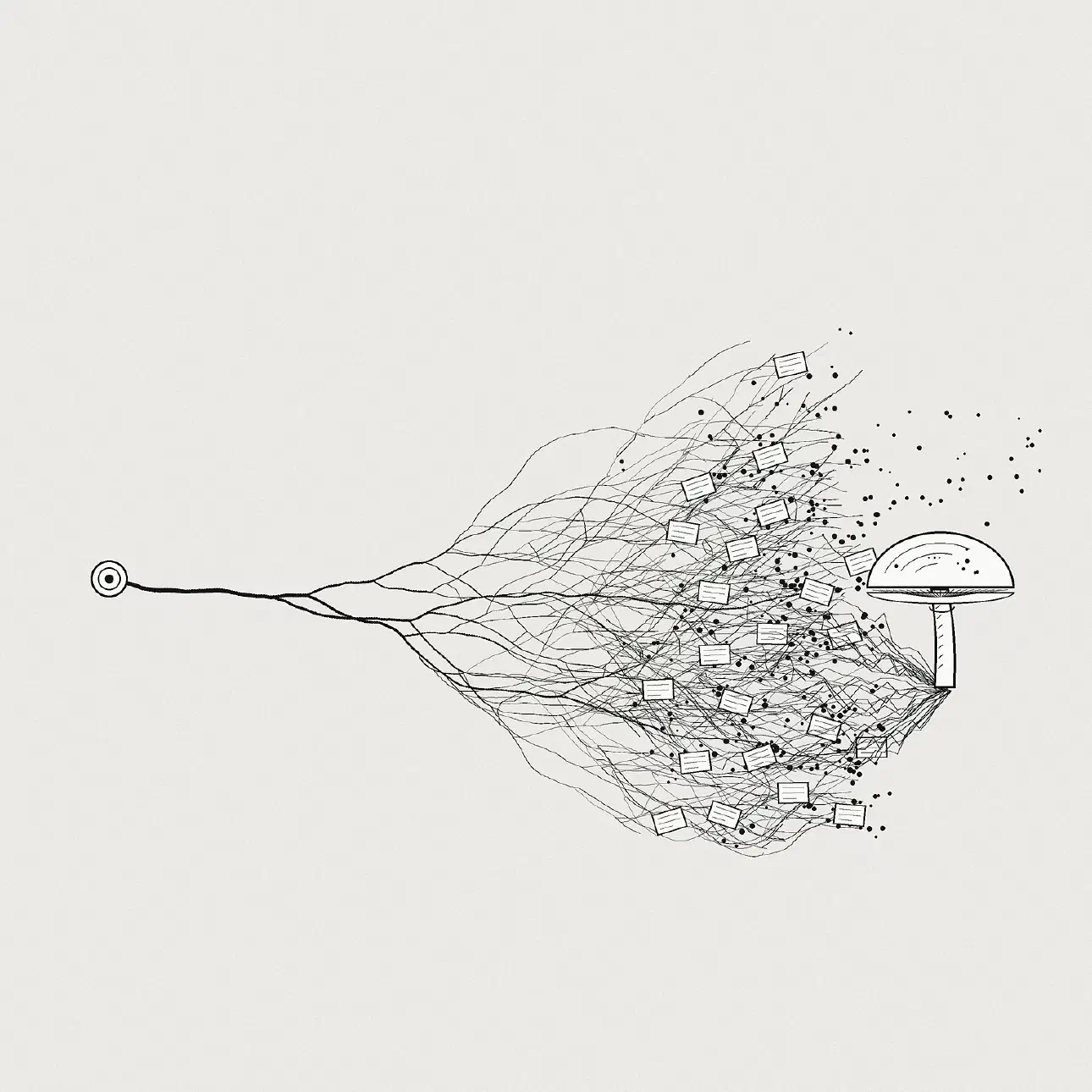
Imagine a glass flask filled with a clear, nutrient-rich liquid, turning slowly on a magnetic stirrer. At first you see almost nothing. Then, after a few days, fine white threads appear. Each thread grows at its tip, reaches out, forks, and forks again. One day the liquid is laced with a delicate web, and what started as a few invisible cells has become a living network. That is the growth of a hypha, and it is the best picture I know for how a Zettelkasten grows.
From Spore to Thread: How Fungi Really Grow
When we think of fungi, we usually think of mushrooms. But the mushroom is only the fruiting body, the visible tip of a much larger organism. The real fungus lives out of sight as a mycelium: a network of tiny tubular threads called hyphae [1].
A hypha grows in a remarkably simple way. It extends at its tip, exploring its surroundings in search of nutrients. As it grows, it branches. The branches grow and branch again, and where hyphae meet, they can fuse and exchange material. Over time, these simple rules produce a dense, connected web that can transport nutrients across the whole network [1].
Only when the mycelium is well established and the conditions are right does something visible appear: the fruiting body, which releases spores into the world. Those spores land somewhere new, and the cycle begins again.
In a liquid culture you can watch the early stages of this process almost directly: threads appear, lengthen, fork and tangle until the flask is full of mycelium. Nothing in that process is planned from above. The structure emerges from growth at the tips.
Notes Grow Like Hyphae
Now look at your Zettelkasten with the same eyes. A single note on its own is like a spore. It holds potential, but it doesn’t do much yet. The interesting part begins when you write the next note that continues the thought.
That is how a thread of thought begins: one note follows another, each building on the last. In Niklas Luhmann’s Zettelkasten, this was visible in the numbering itself. A note that continued a thought was placed right behind the note it followed, and a note that opened a side thought got a branch number, like 21/3a after 21/3 [2]. The numbering is nothing other than a record of growth at the tip.
Just like a hypha, a thread of notes does not grow in a straight line forever. At some point a note raises a question that deserves its own exploration. The thread forks. Now there are two lines of thought, each growing at its own tip. Later, one of them forks again.
And just like hyphae that meet and fuse, threads that started in very different places begin to touch. A note about learning languages suddenly connects to a note about spaced repetition. A note about Lean production meets a note about how you organize your tasks. These links are the fusions of your knowledge mycelium: places where separate threads begin to exchange ideas.
Branching, Dividing, Fruiting
If you tend a Zettelkasten for a while, you will notice three phases that mirror the fungus remarkably well.
Threads. In the beginning, notes form simple chains. You read something, write a note, add another that continues it. The structure is linear and easy to follow.
Branches. As a topic deepens, threads fork. A single sequence becomes a small tree of related notes, with a main line and several side branches. This is the phase where structure notes, or collecting notes, become valuable: they give you an overview of a region that has grown too large to see at a glance.
Fruiting bodies. Finally, when a region of your Zettelkasten is dense enough, something visible grows out of it: a blog post, a talk, a design decision, a project plan. In my own definition of this blog, these are the spores: articles, projects, works of art, mastered challenges. The fruiting body doesn’t come from nowhere. It is fed by the whole network beneath it.
This is also why good questions can’t be engineered in advance. They emerge only after you have worked with a topic long enough to develop an intuition for it. Like a fungus, your knowledge produces fruit where the mycelium is strong, not where you would like it to be.
Tending Your Knowledge Mycelium: Practical Tips
You can’t force a mycelium to grow, but you can create good conditions for it. Here is what that looks like in practice:
-
Grow at the tips. When you add a new note, ask: which existing thought does this continue? Place it right behind that note instead of filing it in a generic folder. This keeps your threads alive and visible.
-
Let threads fork. When a note opens a side question, don’t squeeze it into the main line. Start a branch. In a digital Zettelkasten, a numbering scheme like
01_012_03makes branching explicit, and tools such as tools4zettelkasten can renumber the hierarchy automatically, so you never have to fear inserting a note in the middle [3]. -
Encourage fusion. Every time you write a note, look for one link to a thread in a different region of your Zettelkasten. These cross-links are where surprising ideas come from.
-
Add structure notes when a region gets dense. As soon as a branch has more notes than you can keep in mind, write a structure note that maps it. It’s the equivalent of stepping back to look at the whole flask.
-
Watch for fruiting bodies. When you notice that a region keeps growing and connecting, that’s a sign it may be ready to bear fruit. Pull its notes together into an outline, and write the article, talk or plan that has been forming underneath.
Let It Grow
The growth of a hypha teaches us patience and trust in simple rules. A fungus doesn’t draw up a master plan. It grows at its tips, branches when there is something to explore, connects where threads meet, and bears fruit when the network is ready.
Your Zettelkasten can work the same way. You don’t need to design its final structure on day one. Write the next note. Let the thread fork when it wants to. Link generously. And one day you’ll look at your notes the way you’d look at that flask on the stirrer, and see a living web where there was once only clear liquid.
What thread in your Zettelkasten is growing fastest right now, and what might it be about to fruit into?
Sources:
[1]: Merlin Sheldrake, Entangled Life: How Fungi Make Our Worlds, Change Our Minds and Shape Our Futures (Random House, 2020).
[2]: Sönke Ahrens, How to Take Smart Notes (CreateSpace, 2017).
[3]: tools4zettelkasten, https://github.com/rreben/tools4zettelkasten